

As artificial intelligence grows more powerful and science reveals ever more about the universe and ourselves, will belief in God eventually become obsolete? Or are the biggest questions precisely the ones science cannot answer?
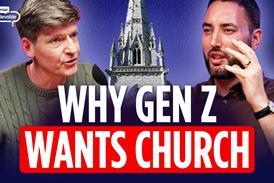
That is the provocative question at the heart of a new Unbelievable debate between two scientists who see reality very differently.
Professor Paul Heslop of Durham University works in mathematical and theoretical physics, including quantum field theory and quantum gravity. He approaches the question as a Christian. Opposite him is Professor Simon Walker-Samuel, Professor of Biophysics and Imaging at UCL, whose research combines biomedical imaging, computational modelling and machine learning. He is also a trustee of Humanists UK. Walker-Samuel and UCL colleague Rebecca Shipley received the Rosetrees Interdisciplinary Prize in 2016 for a computational approach aimed at improving T-cell therapy for pancreatic cancer.
Hosted by Sam McKee before an audience at Sir Henry Floyd Grammar School in Aylesbury, the conversation looks towards the year 2100. With AI, robotics, genetic engineering, personalised medicine and even space travel potentially transforming human life, what place will religion have left?
For Walker-Samuel, scientific progress could contribute to religion’s decline.
“I think science is one of the big reasons that religion might decline,” he says, “because as our understanding of the world increases and we get better at making predictions about the world, we need to rely less on faith-based beliefs.”
But his prediction is more complicated than a straightforward triumph of atheism.
Asked whether people might still practise religion even as humanity ventures beyond Earth, Walker-Samuel says: “I would say probably.”
Why? Because he believes the impulse towards religion and meaning is deeply human. “I still think there’s this inherent human need,” he says.
Heslop agrees that the deepest questions are unlikely to disappear, but reaches a very different conclusion.
For him, studying the mathematical structure of the universe does not push God further away.
“I’ve always seen what I do as trying to understand God’s ideas after him,” Heslop says.
The very success of physics raises further questions: “Why are they simple? Why are they mathematically beautiful? How is it that we can understand them?” These, Heslop argues, are questions that transcend science itself.
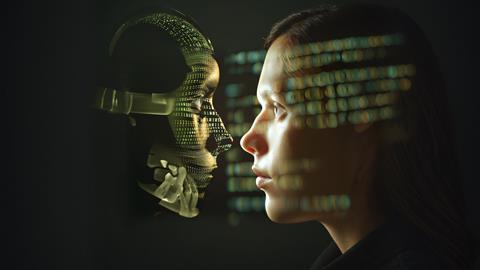
The debate becomes especially provocative when the two scientists turn to AI, consciousness and free will.
Could an artificial intelligence ever become conscious? Walker-Samuel does not believe today’s large language models are conscious, but wonders whether they might nevertheless teach us something unsettling about ourselves.
“Maybe that’s what our brains do,” he says, considering whether human thought itself could operate as a form of predictive model.
Heslop challenges the implications. If our thoughts are simply the predetermined products of physical processes, why should we trust them as true? When Walker-Samuel discusses the possibility that our behaviour is determined, Heslop responds: “Why should I believe what you’re saying if you’re just determined to say that?”
The discussion ranges from quantum physics and evolution to morality, consciousness, the Bible and the historical claims surrounding Jesus.
Yet one striking point of agreement emerges. Neither scientist thinks Christianity should simply be treated as a primitive scientific explanation that will inevitably be replaced when science becomes sufficiently advanced.
For Heslop, science is enormously successful, but limited in the kinds of questions it can answer.
“Science is amazing, beautiful in its own realm,” he says. But beyond it remain questions about truth, meaning, consciousness and why there is something rather than nothing.
Walker-Samuel believes humanity may ultimately explain those questions very differently.
So as AI becomes more capable, medicine extends what human beings can do and science probes deeper into reality, will religion finally disappear?
Or will the questions that made humans search for God prove impossible to engineer away?
Watch the full Unbelievable debate: Paul Heslop vs Simon Walker-Samuel, hosted by Sam McKee.