


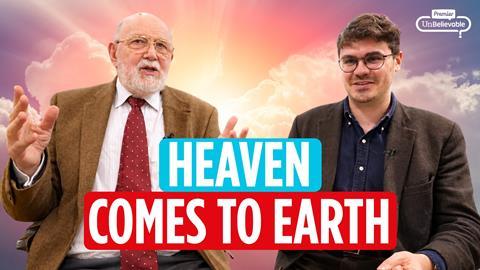
For centuries, Christians have imagined heaven as their final destination. But what if the Bible tells a far more extraordinary story? In a special Unbelievable? conversation recorded at Wycliffe Hall, Oxford, N.T. Wright explains why the ultimate Christian hope is not escaping this world, but God transforming it and coming to dwell with his people.
What if one of Christianity’s most familiar ideas has got the direction of the biblical story backwards?
For many Christians, the hope of the gospel can be summed up simply: when we die, we go to heaven.
N.T. Wright thinks that is not the story Scripture is actually telling.
Speaking to John Nelson at Wycliffe Hall, Oxford, Wright put the challenge starkly:
“The point of Christianity is not that we should go to heaven. The point of Christianity is that heaven should come to us, to Earth.”
For Wright, this is not a minor theological adjustment. It changes how we understand Jesus, resurrection, the Kingdom of God, the Church and the Christian future.
He argues that the early Christian story was not about human souls travelling upwards into God’s presence. It was about God coming “downstairs to live with them” and ultimately filling creation with his presence.
Did Christianity become too focused on heaven?
Wright believes part of the problem lies in the influence of Greek philosophy on later Christianity.
“The Gospel message has all too often been shrunk,” he says. “It’s been turned into a self-help message of how we might find our way up to heaven.”
By contrast, when Jesus spoke about the Kingdom of God, Wright argues, he meant “God becoming king on Earth as in heaven”.
That also changes how Christians understand death.
Questions during the evening raised familiar biblical passages about paradise, being “with the Lord” and the hope of heaven.
Wright does not deny an intermediate state after death. But he insists it is not the final destination.
“Paradise,” he says, “was the blissful place where you go to be refreshed and rested.”
The ultimate hope is resurrection and new creation.
And for Wright, Revelation makes the direction of travel particularly clear:
“Revelation 21… is not about saved souls going up to heaven. It’s about the new Jerusalem coming down from heaven to earth.”
What does that mean for the Church?
If God intends to renew creation, Christians are not simply waiting to leave it.
Wright describes the Church as a “small working model of new creation”, called to show something of God’s future in the present.
That has practical consequences.
“When God wants to get the world back into shape,” he says, “he doesn’t send in the tanks.”
Instead:
“He sends in the poor in spirit, and the meek, and the brokenhearted, and the peacemakers, and the mourners, and the hungry for justice people.”
The conversation also turns to Christian nationalism and the danger of confusing the Kingdom of God with political power.
Reflecting on Jesus’ words, Wright says:
“My kingdom is not from this world… But my brothers and sisters, it is for this world.”
How does this change evangelism?
Another question raised a practical challenge: if Christianity is not primarily about asking people where they will go when they die, how should Christians explain the gospel?
Wright’s answer begins with new creation.
“The God who made the world has launched his decisive plan to remake it and flood it with his own life and love and beauty and justice.”
And then comes the invitation:
“You get the chance, if you want, to be part of that plan.”
For Wright, that does not mean salvation is earned by good works.
Quite the opposite.
“The whole point about God’s homecoming,” he says, “is that it’s grace from start to finish.”
The result is a vision of Christianity that is less about escaping the world and more about God renewing it.
And that, Wright argues, changes almost everything.