


Are young men returning to church because Christianity has become countercultural? Philosopher and theologian Dr Johannes Hartl joins Luke Martin to discuss prayer, smartphones, the promises of the sexual revolution and why secularism may not be a one-way ticket.
“More people actually pray than people would actually say that they firmly believe in God.”
For Dr Johannes Hartl, prayer does not begin with religious language, rigid formulas or presenting God with a list of requests. It begins with something far more universal: gratitude.
He recalls speaking to an atheist who sometimes felt overwhelmingly grateful to be alive, particularly when seeing a sunset or watching his child smile. Hartl responded with a disarmingly simple question:
“Whom are you actually thanking?”
“The most foundational act of prayer is just acknowledging that we didn’t make ourselves,” Hartl tells Luke Martin. “There’s so much in our life that is an undeserved gift.”
Prayer, he argues, is not primarily about saying the right words. It is about turning our attention away from ourselves and towards a greater presence.
But Hartl is equally clear that genuine prayer is not simply a Christian version of relaxation.
‘You will want to run away’
Meditation may calm us, but Hartl believes Christian prayer carries a more challenging claim: that God is actually there.
“If you really pray, you’re also confronted with negative things,” he says. “It’s not just the easy way of quieting down and relaxing and chilling.”
Then comes one of the interview’s most arresting lines:
“You will want to run away if you do it the right way.”
Silence first exposes the noise around us. Then, more painfully, it exposes the noise within us.
Hartl describes returning to prayer after busy periods and struggling for the first two days. Once the external noise subsides, he says, the internal noise begins to surface.
Yet those who are willing not to run away can find “a very solid ground”, something substantial and valuable for their lives.
Building ‘a cathedral in time’
That conviction inspired Hartl to help establish the House of Prayer in Augsburg, Germany.
For around 15 years, people have prayed there continuously, day and night. Hartl says the community has now passed the threshold of 100,000 hours of prayer.
He describes the project using a striking image:
“We actually build a cathedral in time.”
Rather than constructing a vast physical monument, the community is building something from thousands of hours of attention, worship and prayer.
Around 50 full-time staff help sustain the work, supported by part-time staff, volunteers and visitors. Christians from Catholic, Protestant and other traditions pray alongside one another.
Hartl believes their shared purpose makes denominational disagreement easier to navigate.
“Maintaining prayer 24/7 keeps us busy,” he jokes. “So we don’t have so much time to fight about other things.”
‘Your phone won’t help you’
In an age of constant notifications, Hartl considers our fractured attention one of the most urgent questions facing Christian discipleship.
He regularly leaves his smartphone behind for several days of silence and says he has spent recent family holidays without taking it at all.
His advice is uncompromising. Everyone needs a period each year completely away from their phone, as well as a period of deep focus every day.
During that daily period, he says, “your phone is not in the same room with you.”
Even its silent presence can leave the brain waiting for the next message.
Hartl also periodically deletes Instagram, despite using the platform to reach a large audience.
“Sometimes we have to use technology in order to advertise a life that is not dominated by technology.”
He is particularly concerned about children receiving smartphones too young.
“If you have kids, you want to give them a phone as late as possible,” he says. “Your relationship to your kids and all of their life will change dramatically on the first day they get this.”
He predicts that smartphone bans in schools, which can still appear radical, will soon be considered common sense.
Why are young men returning to church?
Hartl has also noticed growing spiritual openness among younger Europeans, particularly men.
He is careful not to describe every sign of spiritual interest as a movement of God or a full-scale revival. Social frustration and cultural rebellion may also be playing a role.
“Young, frustrated, sometimes angry men have always been those who oppose the mainstream,” he explains.
In earlier generations, rebellion might have meant joining the hippies or the punk movement. But when the cultural establishment is perceived as secular, liberal and relativistic, attending church can itself become an anti-establishment act.
Hartl puts it provocatively:
“Christianity is becoming sexy for them, for some of them.”
He believes these young men could be at the leading edge of a wider cultural shift.
“I don’t believe that we have already seen the end of it.”
The old secularisation story assumed societies travelled in only one direction, inevitably moving from religious belief into unbelief. Hartl thinks that confidence is beginning to crack.
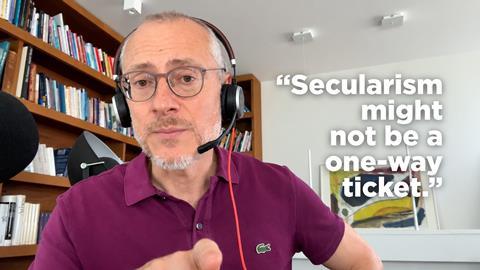
“Secularism might not be a one-way ticket.”
‘We’ve been fed something that didn’t nourish us’
Why might a new generation be looking elsewhere?
Hartl believes some of modernity’s greatest promises have failed to deliver.
The promise was that greater prosperity, more possessions and the freedom to choose any lifestyle would make people happy. Instead, he argues, many have become lonelier, more frustrated and more depressed.
“We’ve been fed something that actually didn’t nourish us.”
He makes a similarly provocative argument about the sexual revolution.
Hartl rejects the idea that steadily increasing sexual freedom must inevitably produce happier individuals and societies.
“The great promises of the 68 movement,” he says, “have not really aged well.”
His point is not that Christians should retreat into nostalgia. He is deeply suspicious of pessimists who imagine there was once a perfect period to which society could return.
“What I hate about the pessimists, it always sounds like, ‘Oh, back then the times were so much better.’ Oh, really? When exactly was that time when the past was so bright?”
Christians, he insists, should be people of hope.
What are Christians actually building?
Hartl believes it is easy to condemn society but much harder to create a compelling alternative.
“Everybody can easily tell you what they are against. It’s way more difficult to say what they are actually for or what they are actually building.”
His proposed answer is not merely a political programme or the restoration of a list of “Christian values”.
Values themselves, he warns, can become distorted when separated from their proper centre. Even virtues such as tolerance, forgiveness or generosity can become destructive when treated as absolute and detached from a wider moral order.
For Hartl, Christianity is not ultimately centred on a value system.
Its centre is a person: Jesus Christ.
He believes Christian communities should become practical “schools” for learning how to live, form relationships, build families and become mature adults.
Europe was once shaped by monasteries whose common life brought spiritual formation, education and stability. Hartl wonders whether new forms of Christian community could play a similar role today.
Church hurt and unhealthy Christianity
The conversation also turns to those who have been wounded by churches or disillusioned by Christian leaders.
Hartl does not minimise the problem.
“There is a lot of abuse in the Church, a lot of immaturity,” he says.
He believes many churches have failed to integrate spiritual formation with psychological and emotional health. Some people have been taught to suppress their emotions or their real personality in order to imitate an idealised religious identity.
“This is very immature Christianity,” Hartl says.
For those who have been hurt, he offers permission rather than condemnation:
“It’s totally normal to deconstruct. It’s totally normal to question, to take your time off.”
But he also urges people not to assume that the distorted expression of Christianity they encountered is all that Christianity can be.
Disillusionment, although painful, can remove an illusion and open the way to something more truthful.
“It’s always better to be disillusioned than to live in an illusion,” he says. “God will meet you at the bottom of reality and not way up there where we just make up things.”
In this wide-ranging conversation, Johannes Hartl and Luke Martin explore unanswered prayer, digital distraction, young men’s interest in Christianity, church hurt, emotionally unhealthy faith and the possibility of a new Christian renewal.
Listen to the full conversation with Dr Johannes Hartl on Unbelievable? The Interview, and check out Dr Hartl on tour https://johanneshartl.org/endlichankommen/.