

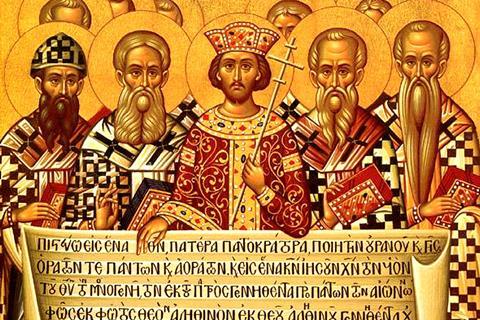
For centuries, Christians have looked to the great ecumenical councils as landmarks of orthodox belief. Nicaea, Chalcedon and the creeds that emerged from them helped define how the Church speaks about God, Jesus Christ and the Trinity.
But can Christians ever question them?
That is the challenge put to N.T. Wright in this episode of Ask N.T. Wright Anything. A listener asks whether Christians should trust that the Holy Spirit protected the great councils from error, or whether their arguments and conclusions should still be examined critically.
Wright’s answer begins somewhere even more fundamental.
“All authority belongs to God and is vested in Jesus Christ.”
For Wright, that means neither a council nor even a theological system can become the ultimate authority for Christian faith. Scripture has a unique role because it bears authoritative witness to Jesus.
But that does not mean reading the Bible is simply a matter of finding a verse that settles an argument.
“Scripture has to be wrestled with. It’s the kind of book that demands engagement.”
That distinction matters when Christians look back at famous councils such as Nicaea and Chalcedon.
Wright is clear that these councils were addressing enormously important questions. Yet he also warns against treating their conclusions as though they ended theological reflection forever.
“They do not, in my view, always grasp what Scripture is actually doing.”
The danger, he says, is that Christians can begin to think a theological question was debated, settled and therefore closed.
But Wright argues that Scripture works differently. The deeper Christians go into it, the more it should drive them towards further prayer, study, discussion and faithful witness.
So what, then, are creeds for?
Wright gives them an important but carefully defined role. The great creeds can function as boundaries or guardrails, helping Christians recognise when an interpretation has moved far outside historic Christian belief.
“The creeds are there as kind of guidelines in case, in our excited wrestling with and engagement with Scripture, we’ve gone completely off the rails.”
That is a long way from dismissing the creeds. But it is also very different from treating them as the foundation of Christianity.
Wright puts the distinction sharply:
“The creeds are not the substance of the faith. Jesus is the substance of the faith.”
Scripture, he says, bears primary witness to Jesus, while the creeds are the attempts of “wise people, prayerful people” in earlier generations to express faithfully what Christians needed to say in their own historical circumstances.
That means theology is never simply a matter of inheriting previous answers.
Wright points to the Reformation as an example. Luther and Calvin, he says, were right to return to Scripture and challenge established traditions. But he imagines those same reformers telling later generations not merely to repeat their conclusions.
“Look at what we did and don’t take our word for it. You go and do it yourself, and if possible, do it better.”
For Wright, that has been a guiding principle throughout his own theological career.
It also means Christians should beware of constructing tightly ordered theological systems and then adding Bible verses afterwards to support them.
The deeper question is always whether Christians really believe in the authority of Scripture, or simply in the authority of a theological scheme that happens to contain biblical references.
None of this makes historic Christian tradition irrelevant. Quite the opposite. Wright clearly believes the councils and creeds deserve serious respect.
But respect is not the same as unquestioning acceptance.
Every generation, he argues, must return to Scripture, understand it in its historical and biblical context, listen carefully to the wisdom of the Church, and then ask again what faithful allegiance to Jesus requires.
Perhaps the most provocative implication is also the simplest:
Christian orthodoxy is not ultimately loyalty to a council, a confession or a theological system.
It is loyalty to Jesus Christ.
Watch or listen to the full conversation on Ask N.T. Wright Anything.