

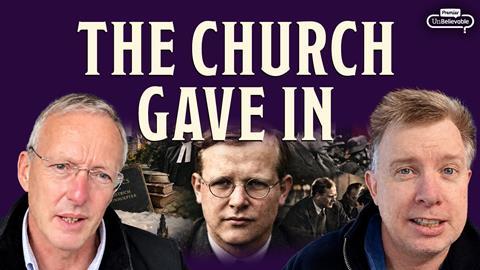
Dietrich Bonhoeffer has become a symbol of Christian resistance to tyranny. But has the real man been obscured by myth? Historian John McCabe joins Mike Bird to separate Bonhoeffer from the versions later generations have created.
Dietrich Bonhoeffer has become one of the most famous Christian figures of the 20th century: pastor, theologian, opponent of Hitler and ultimately a victim of the Nazi regime.
But fame creates its own problem.
Everybody wants Bonhoeffer on their side.
In the first of a special three-part History’s Last Stand series, Mike Bird is joined by historian John McCabe, author of Dietrich Bonhoeffer: The Last Eight Days, to ask a deceptively simple question: who was the real Dietrich Bonhoeffer?
Bonhoeffer was only 39 when he was executed at Flossenbürg concentration camp in April 1945. Yet before his death, he had already become a significant theologian, helped shape resistance within the German church and wrestled deeply with what Christian discipleship meant under dictatorship.
As Mike puts it, Bonhoeffer was someone “wrestling with what it means to follow Christ” while “the storm clouds of war are gathering”.
When the church confronts the state
One of the most striking parts of Bonhoeffer’s story is the battle for Christianity within Germany itself.
As the Nazi regime sought to bring Protestant churches into line, the so-called German Christians embraced elements of Nazi ideology.
McCabe describes churches with “swastikas on your altars”, an “Aryanized” Bible and Nazi supporters installed in positions of church leadership.
The Confessing Church emerged in opposition, declaring that Christianity could not simply be remade in the image of the state.
Bonhoeffer’s resistance was not simply political. It grew out of his theology.
At the seminary he led at Finkenwalde, future pastors prayed, studied scripture, worshipped, sang and lived in community. His students even complained: “Are you trying to make us into monks?” McCabe explains that Bonhoeffer wanted ministers to become people “passionate about a relationship with God and grounded in discerning God’s will”.
Have we invented our own Bonhoeffer?
The episode also tackles a more uncomfortable question: what happens when later generations appropriate historical figures for their own causes?
Discussing the recent Bonhoeffer film, McCabe is strikingly clear.
“I don’t think it has very much connection with the Dietrich Bonhoeffer who I’ve got to know through detailed study and research,” he tells Mike.
He says the filmmakers created “an imaginary figure which is quite an appealing story”.
Mike responds with a line which captures the problem perfectly: “Bonhoeffer is the figure that everybody wants on their side.” That is exactly why getting the history right matters.
McCabe spent five years returning to sources, tracing families connected to Bonhoeffer’s final companions and reconstructing events rather than simply repeating the conclusions of earlier biographies.
That historical detective work forms the basis of this three-part series.
In episode one, we discover the man and the choices that brought him into confrontation with Nazism.
In part two, Mike and John turn to Bonhoeffer’s extraordinary final eight days and the journey that ended at the gallows of Flossenbürg.
Watch or listen to part one of our Dietrich Bonhoeffer series now.
And if you want to understand why History’s Last Stand exists in the first place, catch up with Mike Bird’s two previous conversations with historian Sarah Irving-Stonebraker. Together they explore why historical knowledge matters, what happens when societies lose touch with their past and why recovering history matters for understanding the present.
Dietrich Bonhoeffer - The Last Eight Days: The Untold Story of the Journey to Flossenbürg: https://amzn.to/4zVy9X6
HLS on Apple Podcasts: https://podcasts.apple.com/us/podcast/historys-last-stand/id6793986584