



The final part of a four-part series: From Theistic Evolution to Intelligent Design: Why I changed my mind
Read part 1: Wrestling with the Divide - Why I Couldn’t Keep Faith and Science Apart Anymore here
Read part 2: When the Stones Cry Out - Intelligent Design and the Voice of Creation here
Read part 3: The Blueprint and the Biopsy - Finding God in Design, Not Just Morality here
Scientific Parables
Swamidass suggested Christians shouldn’t presuppose that we can see evidence of God’s mind in the world because in the end, He is beyond knowing:
“God providentially governs all things…but we don’t know how he does this unless He tells us…That’s the orthodox Christian position.”
While there is a significant difference between Creator and created, we have been made in His image, which should at least give us a clue as to what He was thinking. God’s thoughts are higher than ours, but he also made some of them known to us when He physically spoke them into existence. A God who teaches us through parables of vines, wheat, seeds and sheep surely likes to speak to us through proteins and nucleotides.

Lion Lies Down with Lamb
I’m afraid that theistic evolution tries to unite science and faith by reintroducing Stephen J. Gould’s non-overlapping magisteria. But what if the magisteria actually overlapped? What if a speaking God recited a DNA code?
What if a God who told the oceans “thus far and no further” established laws of gravitation? What if a God who said “let there be light” gave it a specific speed? What if the God who “weighed the mountains on the scales and the hills in a balance” created tectonic plates? What if the biological writing is on the wall? Do we treat it as if it is human graffiti or the work of the finger of God?
Clothed in Christ, we shouldn’t put God on a hanger when we don our laboratory coat. If science and faith aren’t able to join hands and make their way from the academic bench to the bedside of a world that is physically and spiritually dying, then they will have both failed at their most important task.
The good news is that theistic evolutionists and intelligent designers both worship a God who died for their sins. And, while we may differ about the scientific details, we know that we will all get together in the new heaven and earth for the ultimate scientific conference where the featured speaker will be God Himself.
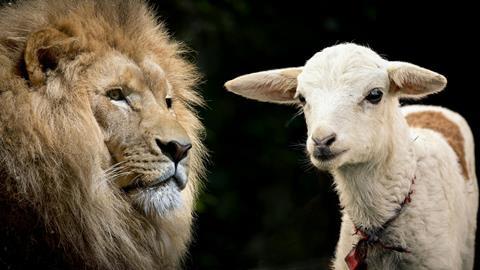
My hope is that one day the lion of science will lie down with the Lamb of God. The scientific journal will be on the same bedside as the Bible. Until that day comes, we need more conversations like the one between Swamidass and Behe on Unbelievable?.
Erik Strandness is a physician and Christian apologist who practiced neonatal medicine for more than 20 years and has written three apologetic books. Information about his books can be found at godsscreenplay.com.