



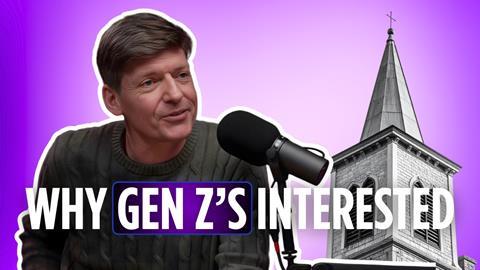
In a new episode of Premier Unbelievable, Luke Martin speaks to Glen Scrivener about why younger people may be asking different questions about faith, not just whether Christianity is true, but whether it can make sense of identity, meaning and modern life.
For years, the big Christian apologetics questions seemed fixed: Does God exist? What about suffering? Can science explain everything? But in a striking new episode of Premier Unbelievable, host Luke Martin speaks with Glen Scrivener about why a new generation may be asking something different.
Not first, is Christianity true?
But rather, can Christianity help us live?
That shift matters.
In Luke Martin’s conversation with Glen Scrivener, author of The Air We Breathe, the focus is not on a full-scale revival or a simplistic culture-war victory lap. Instead, Scrivener points to something subtler but still significant: a rising openness among younger people to the possibility that Christianity may offer real answers in a culture marked by confusion, alienation and moral exhaustion.
His argument is not that Gen Z has suddenly become conventionally religious. It is that many are no longer as confident as previous generations that secular culture can sustain meaning, identity and hope on its own.
A new kind of openness
Scrivener describes what he sees as a “step change” in 2025: not a mass return to church, but a noticeable increase in willingness to investigate faith. That might mean turning up on a Sunday, buying a Bible, or simply becoming more curious about Christian belief.
What is especially interesting is the kind of questions people seem to be asking.
According to Scrivener, the old “new atheist” objections have not disappeared, but they are no longer always first in line. For many younger people, the more immediate questions are deeply personal and cultural:
How do I live? What does it mean to be a man or a woman? What kind of community can I trust? What has gone wrong with the modern world?
That is a very different starting point from the apologetics climate shaped by Richard Dawkins and Christopher Hitchens.
As Luke Martin suggests in the interview, Gen Z may simply not carry the same baggage. They did not all come of age in the shadow of the new atheism. Many are less interested in fighting yesterday’s battles and more interested in finding a way to live in today’s fractured world.

From arguments to plausibility
One of the most arresting themes in the episode is Scrivener’s claim that people often do not “think” their way into a new life so much as “live” their way into a new way of thinking.
That does not mean truth no longer matters. It means that belief is often shaped in the context of community, practice and embodied example.
In other words, many people are not first looking for a watertight syllogism. They are looking for a life that makes sense.
That helps explain why church, Bible reading and Christian community may become attractive even before someone has resolved every intellectual objection. Scrivener argues that in an age of atomisation, institutional collapse and identity confusion, the church can begin to look less like the problem and more like one possible answer.
Why now?
The interview also connects this renewed interest to a wider cultural mood.
Scrivener suggests that the assumptions of the last 20 years are no longer holding. Confidence in institutions has eroded. Individualism has left many people isolated. Gender ideology has raised profound questions that mainstream culture has not answered well. Even those who reject toxic online masculinity are often still asking whether there is a healthy vision of manhood and womanhood on offer anywhere.
And that is where Christianity starts to look freshly relevant.
This is one of the key claims behind Scrivener’s wider work: that many of the values modern people cherish - dignity, freedom, compassion, equality - are not floating free. They have deep Christian roots. Even people who do not yet believe may be living on inherited moral capital.
That argument has gained wider traction in recent years, not least through Tom Holland’s Dominion and conversations now happening across podcasts, publishing and public debate.
It also surfaced recently in Scrivener’s high-profile conversation with Alex O’Connor on Justin Brierley’s Uncommon Ground, where they debated whether the West’s moral instincts are more indebted to Christianity than secular people often realise. The question clearly has cultural energy now and this new interview with Luke Martin brings it down from the level of abstract debate to the level of lived reality.
More than a trend piece
What makes this episode worth watching is that it does not just describe a trend. It asks what the Church should do with it.
Scrivener is cautious. He does not want Christians to confuse interest with revival, or renewed openness with cultural dominance. If anything, he warns against triumphalism. The Church may yet grow in fruitfulness while also facing greater hostility.
But that is precisely why this conversation matters.
If younger people are becoming more open to Christianity, they are not necessarily looking for slick answers or culture-war slogans. They are looking for something deeper: truth that can be lived, a vision of humanity that is humane, and a community that can carry conviction without collapsing into either compromise or rage.
That is why Luke Martin’s conversation with Glen Scrivener is so timely. It gets beneath the headlines and asks what kind of moment this really is, and what it might mean for the future of faith in Britain.
Watch or listen to the full episode of Premier Unbelievable with Luke Martin and Glen Scrivener to hear the full conversation.