


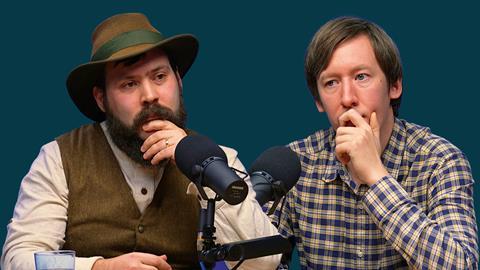
In a dense but fascinating Unbelievable exchange, Caleb Woodbridge and Thomas Walker-Werth debate whether morality can be objective without God. For listeners interested in theology but less at home in philosophy, here is a guide to the biggest claims, the most questionable assumptions, and the deeper issues at stake.
Can morality be objective without God?
This episode of Unbelievable brings together Caleb Woodbridge and Thomas Walker-Werth for a serious discussion about morality, human dignity and the good life. Hosted by John Nelson, it asks two deceptively simple questions: is morality objective, and if it is, what makes it so?
If some of the philosophical language feels heavy going, the underlying issues are anything but obscure. This is really a discussion about whether right and wrong are real, whether human beings have inherent worth, and whether care for the vulnerable can survive once morality is detached from God.
What makes the conversation especially interesting is that Woodbridge and Walker-Werth agree on more than listeners might expect. Neither is a moral relativist. Both believe morality is real. Both care about human flourishing. But the deeper the conversation goes, the clearer it becomes that they are building on very different foundations.
Morality is real - but what makes it real?
Walker-Werth argues from the perspective of Ayn Rand’s Objectivism. He says morality is objective because reality is objective: there is one world, one truth, and human beings can use reason to discover how to live well within it.
Woodbridge agrees that morality is objective, but says reason alone cannot fully ground it. For him, morality points beyond itself to the character of God. We may perceive moral truth, but we do not create it; it is rooted in a deeper reality.
That is the first major divide in the programme. The disagreement is not mainly over whether morality exists, but over what gives it authority.
Walker-Werth’s first big challenge: Christianity asks people to give up happiness for an afterlife that never comes
One of Walker-Werth’s sharpest claims is that Christianity can lead people to delay or forgo happiness in this life for the sake of a hoped-for afterlife for which, in his view, there is no evidence. He sees that as not just mistaken but tragic. He presents Christian sacrifice as too often involving the postponement of flourishing
It is a striking line, but it depends on a very particular reading of Christian faith. Historic Christianity does not simply say, “be miserable now and compensated later”. It says that life with God begins now, that joy and holiness are not enemies, and that self-giving love is not the opposite of flourishing but part of its deepest form.
So the real clash here is not simply between belief and unbelief. It is between two rival accounts of happiness itself. Walker-Werth treats Christian sacrifice as a surrender of flourishing. Woodbridge presents it as the path to a fuller kind of flourishing, grounded in relationship with God.
Is the Christian notion of ‘fallenness’ anti-human?
Walker-Werth also objects strongly to the Christian doctrine of sin or fallenness. He contrasts it with what he sees as a more heroic, classical view of humanity: people as noble, capable, creative and full of potential. Walker-Werth objects to what he sees as Christianity’s diminished view of human nature, the idea that human beings should fundamentally see themselves as corrupted.
That criticism has emotional force, especially in a culture that is suspicious of anything that sounds like guilt or self-denial. But Woodbridge’s response is one of the strongest parts of the episode. Christianity, he argues, does not deny human greatness. It explains why greatness and brokenness exist side by side.
That is a crucial distinction. Christianity is not committed to the idea that human beings are worthless. Quite the opposite: it says human beings bear the image of God and therefore possess extraordinary dignity. But it also insists that something has gone badly wrong in us. We are capable of beauty and brutality, compassion and cruelty. Any serious account of human nature has to explain both.
That means the real question is not which anthropology sounds more uplifting. It is which one best fits the world as it actually is.
Where the secular case starts to wobble: dignity without deep obligation
Walker-Werth wants to defend human dignity, and at points he does so movingly. He says rational beings deserve rights and respect. He speaks warmly about human potential and about the value of a flourishing society.
But once he grounds morality in rational self-interest, however carefully defined, a problem quickly emerges. What happens to those who are not strong, productive or independent? What happens to the sick child, the disabled person, the spouse with terminal illness?
This is where Woodbridge presses hardest, and rightly so. He asks whether Walker-Werth’s framework can really say that someone is wrong to walk away from a dependent loved one when that care becomes costly and inconvenient.
Walker-Werth’s answer is humane in tone. He appeals to chosen obligations, loyalty, self-respect and the sort of guilt that would follow from abandoning those we value. His framework appears to ground sacrificial care primarily in chosen obligations, personal value hierarchies and the demands of flourishing, rather than in a universal duty owed equally to every vulnerable person as such.
That is why Woodbridge’s challenge lands so powerfully. At moments, there is a tension between the generosity of his moral instincts and the structure of the philosophy underneath them.

The most unsettling part of the discussion
The darkest moment in the episode comes when Walker-Werth discusses people who have lost rational function so completely that, in his view, they are no longer really functioning as persons in the full sense. He asks what exactly is being protected when such a life is prolonged and suggests that, at some point, we may simply be preserving biological existence rather than meaningful human life. This is where the conversation moves from abstract philosophy into ethically fraught territory, because once human worth is tied closely to rational capacity, difficult questions quickly arise about how society regards its most vulnerable members.
To be fair, Walker-Werth is trying to think seriously about tragic situations. But once human worth is tied closely to rational capacity, productivity or present cognitive function, the weakest become vulnerable. The circle of full moral concern can begin to narrow.
Woodbridge sees the danger immediately. His concern is not only about extreme cases, but about the broader direction of travel. If society loses the Christian conviction that every human being bears God-given dignity, what stops our moral concern contracting over time?
That question matters far beyond this podcast. It touches debates about assisted dying, severe disability, dementia, end-of-life care and the status of unborn life.
More than materialism - but not enough?
One of the more interesting features of Walker-Werth’s position is that he does not sound like a flat, reductive atheist. He rejects the idea that consciousness, freedom or the inner life can simply be denied away. In that sense, describing himself as an atheist objectivist, he distances himself from more hard-edged forms of materialism.
That makes his case more substantial than a simple “humans are just matter” argument. Yet a tension remains. He wants to affirm consciousness, dignity, value and even something like the soul’s depth, but without God and without transcendence.
That raises an important question for Christian listeners: can a secular worldview keep all this rich moral language once it has severed its roots? Or is it still borrowing from an older moral inheritance?
Woodbridge hints at exactly this point when he suggests that secular societies may still be living off Christian assumptions about the value of persons, even after losing confidence in the beliefs that originally grounded those assumptions.
Is God really an arbitrary assertion?
Walker-Werth says belief in God is an arbitrary assertion - a claim without evidence and therefore without real philosophical standing. Better, he suggests, to admit the limits of our knowledge than to fill the gaps with religion.
That sounds decisive, but it passes too quickly over the actual Christian claim. Woodbridge is not using God to plug a temporary hole in scientific explanation. He is arguing that features of reality such as objective morality, consciousness, meaning and the existence of the universe itself may point beyond themselves.
That is not a lazy appeal to mystery. It is an argument about the best explanation of the world we all experience.
Walker-Werth may remain unconvinced, but calling belief in God arbitrary does not really do justice to the intellectual tradition he is dismissing. Classical theism has never presented God as a random guess. It has presented God as the deepest explanation for why reason works, why moral truths bind, why persons matter and why anything exists at all.
What Woodbridge does well
Woodbridge handles the discussion carefully and intelligently. He does not reject reason or retreat into mere assertion. He affirms the importance of evidence, the reality of human flourishing and the objectivity of morality. That gives the conversation genuine overlap instead of easy caricature.
He also offers a richer account of Christian sacrifice than many critics expect. The Christian call to self-giving is not self-erasure. It is rooted in the character of God and aimed at a deeper joy than mere short-term comfort can provide.
Most importantly, Woodbridge keeps drawing attention to a truth Christian theology has long insisted upon: reason matters, but reason alone cannot explain either our moral knowledge or our moral failures. We do not simply need clearer thinking. We need grace, truth and restoration.
The questions this episode leaves behind
This debate is worth hearing not because it settles these issues, but because it exposes where the real fault lines lie.
Can morality really remain objective if it is grounded in self-interest, however refined? Can human dignity survive if it depends on rational function rather than being rooted in what a person is? Can a secular moral system consistently protect the weak once it detaches worth from divine image-bearing? And does Christianity diminish humanity - or does it actually explain more honestly why we are both magnificent and morally fractured?
These are not remote academic puzzles. They shape how we think about the vulnerable, the dependent, the elderly, the disabled and the meaning of a good society.
Final thoughts
Thomas Walker-Werth offers an energetic and, in places, compelling secular vision. He wants human beings to be free, rational, creative and alive to possibility. There is something attractive in that ambition.
But as the conversation unfolds, the pressure points become clear. On sacrifice, on the status of the weak, on the meaning of dignity and on the source of moral obligation, Objectivism seems less secure than it first appears.
That is what makes this such a useful episode for Christian listeners. It shows that the deepest disagreement is not about whether morality matters. It is about what kind of universe could make morality finally real - and what kind of vision of the human person can keep the weakest among us safe.