


When atheist Oxford chemist Peter Atkins told John Lennox that Christians cannot be rational, Lennox had a question for him: what about Christian Nobel Prize-winning scientists? Atkins’ response was brutally brief: “Grow up.”
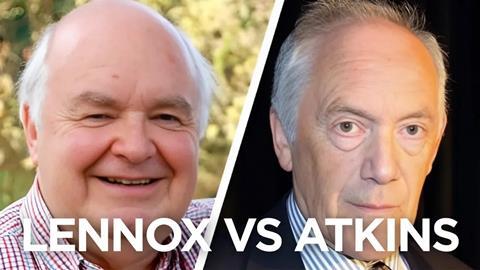
It was one of many extraordinary exchanges in a debate that quickly moved beyond the familiar question of whether science and Christianity are compatible.
Oxford professors John Lennox and Peter Atkins found themselves arguing about something far bigger: whether science can ultimately explain everything, whether there is any evidence that could persuade an atheist God exists, whether morality needs God and, most fundamentally, why there is something rather than nothing.
At times, the gloves really did come off.
“You can’t be rational and a Christian”
One of the sharpest moments came after an audience member described being a longstanding atheist who had gradually become convinced there was evidence for a transcendent creator, while emotionally struggling to accept the conclusion.
Lennox advised taking the questions seriously, continuing to investigate and being prepared, eventually, to make a commitment if the evidence warranted it.
Atkins had very different advice:
“Hang on to his commitment to rationality.”
Lennox immediately replied that he wanted the questioner to remain rational too.
Atkins responded:
“You can’t be rational and a Christian.”
Moderator Justin Brierley remarked: “The gloves are off.”
Lennox then asked:
“What do you say to a Nobel Prize-winning physicist who’s a Christian?”
Atkins’ answer?
“Grow up.”
When Brierley asked whether Atkins could understand why that might sound “incredibly arrogant”, Atkins simply replied:
“No.”
It is funny, uncomfortable and revealing, but it also exposes one of the deepest disagreements of the entire conversation. Are faith and reason necessarily enemies, or can religious belief itself be a rational conclusion?
Is there anything that could convince Peter Atkins God exists?
Perhaps an even more revealing moment came when Atkins was asked what evidence would cause him to abandon atheism.
His answer was startling:
“I simply can’t think of any.”
He went further:
“I don’t think there can be any evidence.”
Brierley pressed him. Did that mean his position was unfalsifiable?
Atkins said yes.
Even if he were standing at the foot of the cross and saw the resurrection with his own eyes, he said:
“I would put it down to hallucination.”
For Lennox, this raised an obvious problem. Lennox insisted his own Christian belief could, at least in principle, be overturned. Evidence that the Gospel accounts were unreliable, or a convincing alternative explanation for the resurrection, would force him to reconsider.
He argued that he had spent much of his life deliberately exposing his Christian convictions to their strongest atheist alternatives because, as he put it:
“I don’t want to be fooled.”
Atkins’ response when Lennox asked whether he similarly questioned his own atheism?
“I see no reason to do that.”
For viewers interested not simply in Christianity or atheism, but in how we decide what counts as evidence in the first place, this may be the most important part of the debate.
“Never happened”
The disagreement becomes particularly fierce when the conversation turns to the resurrection of Jesus.
Atkins is unequivocal:
“Never happened.”
He argues that once a body is dead and beginning to decay there is no natural mechanism by which it can reconstitute itself.
“It’s absurd.”
Lennox’s response is that this misunderstands the Christian claim.
Christianity is not proposing that Jesus’ body spontaneously came back to life through ordinary physical processes. It is claiming an intervention by God.
Lennox uses a typically memorable analogy. If he puts £100 into a hotel drawer on two successive nights, he expects £200 to be there. If he opens the drawer and finds only £50, he does not conclude that arithmetic has stopped working.
The regularity of arithmetic is precisely what allows him to recognise that something else has happened.
In the same way, he argues, knowing that dead people ordinarily remain dead does not logically demonstrate that God could never raise somebody from death.
Atkins is unimpressed. For him, religious explanations which resort to “God did it” are:
“intellectually lazy”
and eventually:
“intellectually corrupt.”
Lennox counters that Atkins is confusing two different forms of explanation. Science can explain how something works, he says, without answering why it exists at all.
His analogy is simple:
“God no more competes with science as an explanation of the universe than Henry Ford competes with physics as an explanation of the motor car.”
Can something really come from nothing?
Then comes one of the strangest and most fascinating parts of the discussion.
Atkins argues that the universe does not require a creator. Brierley picks up a phrase Atkins had used elsewhere:
“Nothing rolled over into something.”
Lennox immediately responds:
“It sounds like nonsense to me.”
What exactly, he wants to know, does “nothing” mean?
Atkins’ argument is that features of the universe can be understood as pairs of opposites. Positive and negative electrical charge, for example, balance each other. He suggests that what appears to be something may, at a fundamental level, add up to zero.
Science has not yet explained exactly how absolute nothingness separated into these opposites, Atkins admits, but he believes it has substantially simplified the question.
Lennox is deeply sceptical.
He compares the argument to saying that because someone’s credits exactly equal their debts:
“there’s nothing going on at all.”
Atkins answers:
“Yes, I am saying that.”
Few parts of the conversation better illustrate how radically different their starting assumptions are.
For Atkins, the scientific project may ultimately explain why the universe requires no creator.
For Lennox, the very intelligibility and existence of the universe point in precisely the opposite direction.
Can science tell us whether to put arsenic in granny’s tea?
Their disagreement becomes even sharper when morality enters the conversation.
Can science simply explain moral values as products of evolution?
Atkins believes scientific disciplines such as evolutionary biology, psychology, anthropology and ethology can illuminate how morality emerged.
Lennox distinguishes between explaining moral behaviour and establishing what humans ought to do.
He gives one of the debate’s most memorable examples:
“Science, chemistry, I believe, can tell me that if I put arsenic in my granny’s tea, it will give her a pretty rough time.”
But chemistry cannot tell him:
“whether I ought to do it or not to get my hands on her money.”
The question underneath the joke is serious.
Science can tell us what an atomic bomb will do. Can it tell us whether we should drop one?
Can evolutionary history explain why human beings have moral instincts while also giving us objective reasons to say that some actions are genuinely wrong?
The two Oxford professors reach very different conclusions.
“There’s no ultimate hope in your atheism”
The discussion becomes more personal when they turn to death.
Atkins argues that religion can provide comfort, but that comfort should not be mistaken for truth.
Lennox challenges the consequences of Atkins’ worldview:
“There’s no life after death, there’s no resurrection. There’s no ultimate hope in your atheism.”
Atkins does not evade the point:
“No, absolutely.”
He has no hope of existence beyond death, he says, but plenty of hope for enjoying the life he has.
Lennox then raises justice. Countless people die without ever seeing justice done. If death really is the end, he argues, then ultimately they never will.
Atkins agrees.
That brief exchange gets unusually close to the emotional heart of the disagreement. Is Christian hope a comforting delusion, as Atkins thinks, or could our hunger for justice and meaning point towards something real?
Why Christianity rather than another religion?
Towards the end, Lennox faces another challenge: even if God exists, why Christianity?
His answer focuses once again on the resurrection.
Judaism, Islam and Christianity make conflicting historical claims about Jesus, he argues. They cannot all simultaneously be correct. Those claims therefore have to be investigated historically.
But Lennox then makes another argument which he regards as even more distinctive.
Many people, he says, imagine religion as a kind of university course. You enter, follow the teaching, sit the final examination and discover at the end whether you have done well enough.
Christianity, Lennox argues, reverses that completely:
“The acceptance comes at the beginning, not the end.”
He continues:
“I know that I’m accepted. Why? Because I’m very good? No, no, no, no, because of what Christ has done.”
For Lennox, this is the “spectacular difference” at Christianity’s heart.
Atkins is unconvinced. His explanation for Lennox’s Christian faith is rather shorter:
“It’s simply that he was brought up in Ireland.”
And so the argument begins again.
“Science is the way, the truth and the light”
Their final statements could hardly have captured the divide more perfectly.
Atkins deliberately borrows the language of Jesus:
“Science is the way, the truth, and the light.”
Human beings, he says, should be proud that through observation, mathematics, collaboration and reason:
“we apes who have dropped from the trees have gone so far intellectually.”
Lennox has the final reply:
“Science is wonderful. But the God who gave us a world in which science can be done is even more wonderful.”
Two Oxford professors. Two radically different accounts of reality.
Is science steadily making God unnecessary? Or does science itself raise questions that naturalism cannot answer?
Could anything persuade a convinced atheist that God exists? Can a Christian really claim the resurrection as historical evidence? And when science explains how the universe works, has it explained why there is a universe at all?