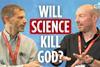



An atheist philosopher and a Christian scientist ask whether the universe looks “designed” or whether we’re reading meaning into the maths. From fine-tuning and multiverses to time, salvation and aliens, this conversation goes to the edge of science and faith.
What do you do with a universe that looks uncannily hospitable to life?
That’s the question hovering behind this Unbelievable? conversation as Andy Kind welcomes two of the show’s most thoughtful regulars: Dr Emily Qureshi-Hurst (Cambridge philosopher of science and religion, and author of Decoding the Cosmos) and scientist-theologian Sam McKee.
Emily begins with a disarming confession: she’s an atheist, but not the Dawkins-style, culture-war kind. She’s suspicious of any worldview that treats science as a totalising explanation for everything that matters. And she’s equally sceptical of Christians who try to build faith on “God-of-the-gaps” arguments. From there, the discussion moves fast.
Fine-tuning: data or “designer”?
Emily traces the long history of design arguments from Aquinas and Paley to modern physics before landing on today’s headline puzzle: cosmic fine-tuning. The conditions of the universe appear astonishingly “just so” for life. But does that point to God, a multiverse… or simply the limits of what physics can currently explain?
Sam’s response is refreshingly restrained. He sees fine-tuning as a genuine problem that atheists can’t shrug off, but he refuses to treat it as a knockdown proof. Faith, he insists, isn’t meant to be propped up by a single clever argument.
A rare Unbelievable moment: critiquing William Lane Craig
Then comes a segment you don’t often hear: a serious critique of William Lane Craig’s Kalam cosmological argument not in a gotcha way, but with philosophical care. Emily challenges whether Craig’s “either science or God” framing is too narrow, arguing we may have physical explanations that remain beyond our scientific reach.
The twist: time, salvation… and aliens
And just when you think this is another science-vs-faith episode, it swerves somewhere stranger (and more fascinating): time theory, salvation, and extraterrestrial life.
If the universe is a “block” where past, present and future all exist, what does that do to Christian ideas of transformation, resurrection, and the end of time? And if intelligent alien life exists, would Christian theology require multiple incarnations or does one incarnation “ripple out” across creation?
It’s the kind of conversation Unbelievable does best: serious, lively, occasionally funny, and never tribal.
Check out Emily’s new book here. And to find out more about Unbelievable regular, and resident polymath Sam “I’m-not-yet-a-Doctor” McKee, go here.
If you’ve ever wondered whether Christianity can survive a scientific age or even thrive in one, this episode is a brilliant place to start.
Listen/watch now and join the discussion: Is fine-tuning evidence of God, a multiverse, or something else entirely?